Why Sandpaper Grit Charts Disagree
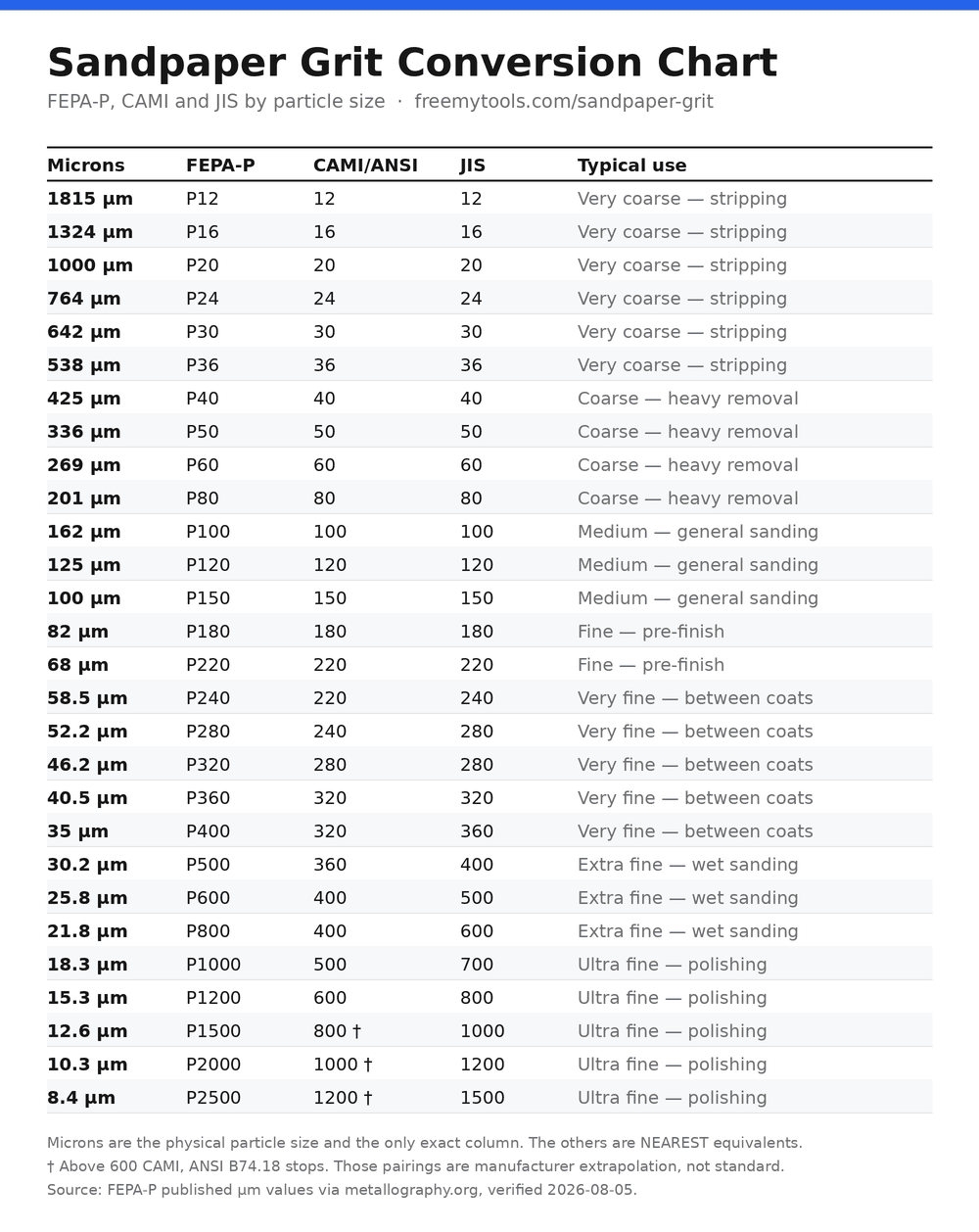
Any CAMI vs FEPA grit comparison runs into the same problem: there are three standards in common use, and they are not interchangeable. CAMI (ANSI B74.18) is the North American system, printed as a plain number. FEPA is the European one, printed with a P prefix. JIS is the Japanese standard, common on waterstones and wet-and-dry paper.
Below about 220 grit the three agree closely enough that you can treat the numbers as equivalent. Above 220 they diverge, and they keep diverging. By the fine end the gap is large: CAMI 600 is roughly P1200, not P600. Buy P600 expecting "600 grit" and you get paper about twice as coarse as you wanted.
The only reliable common ground is particle size in microns, which is why this chart leads with it.
Where the Charts Are Simply Guessing
Here is the part most pages will not tell you: ANSI B74.18 does not define grits finer than 600. There is no CAMI 800, no CAMI 1500, no CAMI 3000 in the standard.
So when a chart confidently lists CAMI equivalents up to 3000 grit, those numbers are manufacturer extrapolations presented as if they were standardised. They are not wrong so much as unfounded — different suppliers extrapolate differently, which is exactly why you will find charts that disagree with each other at the fine end.
This chart marks that boundary rather than papering over it. Above CAMI 600, compare microns and treat the grit number as a label, not a specification.
Grit Conversion Chart
| Microns | FEPA | CAMI | JIS | Typical use |
|---|---|---|---|---|
| 1815 µm | P12 | 12 | 12 | Stripping, heavy shaping |
| 1324 µm | P16 | 16 | 16 | Stripping, heavy shaping |
| 1000 µm | P20 | 20 | 20 | Stripping, heavy shaping |
| 764 µm | P24 | 24 | 24 | Stripping, heavy shaping |
| 642 µm | P30 | 30 | 30 | Stripping, heavy shaping |
| 538 µm | P36 | 36 | 36 | Stripping, heavy shaping |
| 425 µm | P40 | 40 | 40 | Stripping, heavy shaping |
| 336 µm | P50 | 50 | 50 | Stripping, heavy shaping |
| 269 µm | P60 | 60 | 60 | Stripping, heavy shaping |
| 201 µm | P80 | 80 | 80 | Levelling, coarse sanding |
| 162 µm | P100 | 100 | 100 | Levelling, coarse sanding |
| 125 µm | P120 | 120 | 120 | Levelling, coarse sanding |
| 100 µm | P150 | 150 | 150 | General smoothing |
| 82 µm | P180 | 180 | 180 | General smoothing |
| 68 µm | P220 | 220 | 220 | Before paint or stain |
| 58.5 µm | P240 | 220 | 240 | Before paint or stain |
| 52.2 µm | P280 | 240 | 280 | Before paint or stain |
| 46.2 µm | P320 | 280 | 280 | Before paint or stain |
| 40.5 µm | P360 | 320 | 320 | Between finish coats |
| 35 µm | P400 | 320 | 360 | Between finish coats |
| 30.2 µm | P500 | 360 | 400 | Between finish coats |
| 25.8 µm | P600 | 400 | 500 | Between finish coats |
| 21.8 µm | P800 | 400 | 600 | Between finish coats |
| 18.3 µm | P1000 | 500 | 700 | Polishing, wet sanding |
| 15.3 µm | P1200 | 600 | 800 | Polishing, wet sanding |
| 12.6 µm | P1500 | 800* | 1000 | Polishing, wet sanding |
| 10.3 µm | P2000 | 1000* | 1200 | Polishing, wet sanding |
| 8.4 µm | P2500 | 1200* | 1500 | Polishing, wet sanding |
P grade sandpaper conversion here uses FEPA-P average particle size as the reference. CAMI and JIS columns are nearest equivalents, not exact matches. * marks CAMI figures above 600, which are extrapolations — ANSI B74.18 does not define them. Source: metallography.org, verified 5 August 2026.
Free Printable Sandpaper Grit Chart
Print this one and put it on the workshop wall. Grit conversion is exactly the question you have while holding a sheet with the backing paper half worn off, nowhere near a screen — and it is the question a wrong answer costs you an hour of re-sanding. No email, no sign-up.
The printed version keeps the micron column first, because that is the only column that is a measurement rather than a convention, and it carries the same dagger marks for the grades where ANSI B74.18 has stopped and the CAMI figure is extrapolation.
Which Grit to Use
- 40–60 — stripping paint, levelling badly uneven timber. Leaves deep scratches.
- 80–100 — shaping and removing the scratches the coarse paper left.
- 120–150 — general smoothing. Most projects start here.
- 180–220 — final sanding before finish. This is where bare wood should end.
- 320–400 — between coats of varnish or lacquer, sanded lightly.
- 600+ — wet sanding, polishing, and metal finishing. A sandpaper grit chart for metal work lives almost entirely in this range and above.
Never skip more than one step. Each grit's job is to remove the scratches left by the previous one; jumping from 80 to 220 leaves 80-grit scratches that the finish will highlight rather than hide.
Which Grit for Which Material
The progression above is the woodworking default. Other materials want different ranges, and two of them differ enough that following a wood chart will cost you the job — so this is a sandpaper grit chart for wood, metal, cars, drywall and paint in one table, rather than five separate pages saying nearly the same thing.
| Material / job | Start | Finish at | The thing to watch |
|---|---|---|---|
| Bare wood, before paint | 80–100 | 150–180 | Finer is wasted effort — paint hides the scratch pattern |
| Bare wood, before stain | 80–100 | 180–220 | Stop at 220. Past it the fibres burnish and stain goes blotchy |
| Wood furniture, refinishing | 60–80 | 180–220 | Veneer is often under 1 mm — coarse paper goes through it |
| Between finish coats | 320 | 400 | Light pressure; you are knocking off nibs, not removing coat |
| Drywall / joint compound | 120 | 220 | Never coarser than 100 — it tears the paper facing, which shows through paint |
| Metal, rust removal | 60–80 | 220+ | Bare steel flash-rusts within hours — prime the same day |
| Auto body, filler shaping | 80 | 180 | Block-sand, never by hand — fingers leave low spots the paint shows |
| Auto body, primer before paint | 320 | 600 | Check the paint's own data sheet — it specifies the grit it wants |
| Auto body, wet sanding clear coat | 1500 | 2500, then polish | These are FEPA-P numbers. There is no CAMI 1500 — see the warning above |
| Plastic, acrylic, resin | 400 wet | 2000 wet, then polish | Dry sanding melts and clogs; keep it wet throughout |
Two of these are worth stating plainly because they are where a wood-oriented chart misleads. Drywall wants nothing coarser than 100 grit — the paper facing tears, and the fuzz it leaves telegraphs through paint no matter how many coats go on. And automotive wet sanding lives in a range where the standards have already parted company: the 1500, 2000 and 2500 papers sold for clear coat are FEPA-P grades, and there is no CAMI equivalent for them in the standard at all. A chart that offers you a confident CAMI number up there is guessing.
Grit to Microns
Every row in the conversion chart above is anchored to a micron figure, because the particle size is the only value that means the same thing in all three systems. A sandpaper grit to micron chart is therefore the version to trust whenever two numbers disagree: P400 is 35 µm and CAMI 400 is about 23 µm, so they are not the same paper despite carrying the same number.
This also gives you a way to place any abrasive that is not paper. Polishing compounds, diamond pastes, lapping films and stropping compounds are all specified in microns rather than grit, so the micron column is what lets you slot them into a progression alongside sheet abrasive.
The Mistake That Costs a Finish
Sanding bare wood beyond about 220 before staining burnishes the surface — it polishes the fibres closed so they cannot absorb stain evenly. The result is blotchy, and it is not fixable without sanding back and starting again.
For paint, 150 to 180 is enough. For stain, stop at 180 to 220. Save the fine grits for sanding between finish coats, which is a different job with a different purpose.