Beads Per Inch Chart by Bead Size in mm
The maths is one division: 25.4 ÷ diameter in millimetres, because an inch is exactly 25.4 mm. That is exact for round beads strung touching, which is how a plain strand sits on the thread.
| Bead size | Per inch | 7″ bracelet | 18″ necklace |
|---|---|---|---|
| 2 mm | 12.70 | 88 | 228 |
| 3 mm | 8.47 | 59 | 152 |
| 4 mm | 6.35 | 44 | 114 |
| 5 mm | 5.08 | 35 | 91 |
| 6 mm | 4.23 | 29 | 76 |
| 8 mm | 3.17 | 22 | 57 |
| 10 mm | 2.54 | 17 | 45 |
| 12 mm | 2.12 | 14 | 38 |
| 14 mm | 1.81 | 12 | 32 |
| 16 mm | 1.59 | 11 | 28 |
| 20 mm | 1.27 | 8 | 22 |
Seed Bead Sizes — and Why They Vary
Seed beads use the aught system: 11/0, 8/0, 6/0. The number originally described how many beads fitted in a given length, so a higher number means a smaller bead — the opposite of millimetre sizing.
Here is what most charts will not tell you: the aught system is a convention, not a standard. Every manufacturer applied it slightly differently, and they still do. Japanese brands are consistent with each other in the middle of the range; Czech beads and the very small sizes vary most.
| Size | ≈ mm | ≈ per inch | Note |
|---|---|---|---|
| 15/0 | 1.5 | 17 | Most variable size — Czech and Japanese differ noticeably |
| 11/0 | 2.1 | 12 | The default seed bead. Miyuki and Toho are close here |
| 11/0 Delica | 1.6 | 16 | A cylinder, not a round — narrower than a round 11/0 |
| 10/0 | 2.3 | 11 | Mostly Czech; less common in Japanese ranges |
| 8/0 | 3 | 8 | Consistent across Japanese brands |
| 6/0 | 4 | 6 | Often called E-beads |
These are nominal diameters, not specifications. For a large project, lay out one actual inch of your own beads and count — that is the only figure guaranteed to be right for the beads in your hand.
Free Printable Beads Per Inch Chart
Bead counts get worked out with both hands full of findings, which is a poor moment to be scrolling. The button below hands the table to your browser's print dialogue, where every desktop and mobile OS offers Save as PDF — costing you nothing and asking for no address.
The printable version covers round beads only. Seed-bead aught sizes stay on this page rather than the chart, because they are not standardised and every row needs its per-brand caveat beside it — a wall chart of numbers that vary by manufacturer would be exactly the kind of confident-but-wrong reference this page exists to replace.
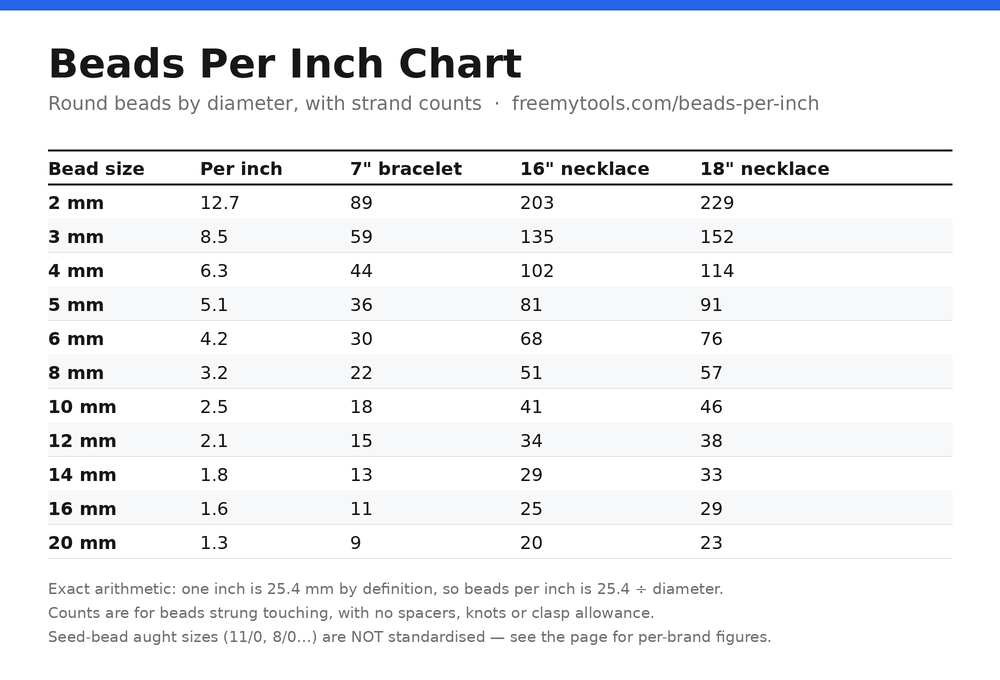
How Many Beads Per Inch, by Size
The two sizes people ask about most are 4 mm and 6 mm, so here they are stated plainly rather than left to be read off a row:
- 4 mm beads — 6.35 per inch. A 7-inch bracelet takes about 44; a 16-inch necklace about 102; an 18-inch about 114.
- 6 mm beads — 4.23 per inch. A 7-inch bracelet takes about 30; a 16-inch necklace about 68; an 18-inch about 76.
- 8 mm beads — 3.18 per inch, so about 22 for a 7-inch bracelet and 51 for a 16-inch necklace.
There is no lookup involved in any of these: an inch is 25.4 mm by definition, so beads per inch is 25.4 divided by the bead diameter. That is why this page can state the round-bead figures exactly while being careful about seed bead sizes, which are a manufacturing convention rather than a measurement.
Working Out What to Buy
- Measure the finished length you want.
- Subtract the clasp — typically 0.5 to 1 inch.
- Multiply the remaining length by beads per inch.
- Add about 10%. Beads break, spacers eat length, and running out mid-strand with no matching dye lot is a genuine problem.
If you are alternating sizes, work out each separately. A pattern of one 8 mm bead and two 3 mm spacers repeats every 14 mm, so a 6.5-inch stringing length holds about 11 repeats — 11 large beads and 22 small — not something the simple per-inch figure will tell you.
Where the Simple Formula Stops Working
- Delicas and cylinder beads. They are not spheres, so they pack flush. Use the cylinder width, not a round-bead figure of the same aught size.
- Bicones and rondelles. The stringing dimension is the height along the hole, not the widest point. Measure the axis the thread passes through.
- Knotted strands. Pearl knotting adds roughly 1 to 2 mm between every bead, which over an 18-inch necklace removes several beads from the count.
- Memory wire and stiff cores. Beads sit slightly apart on a curve, so the effective count drops a little on tight radii.