Knitting Needle Size Chart: US to mm
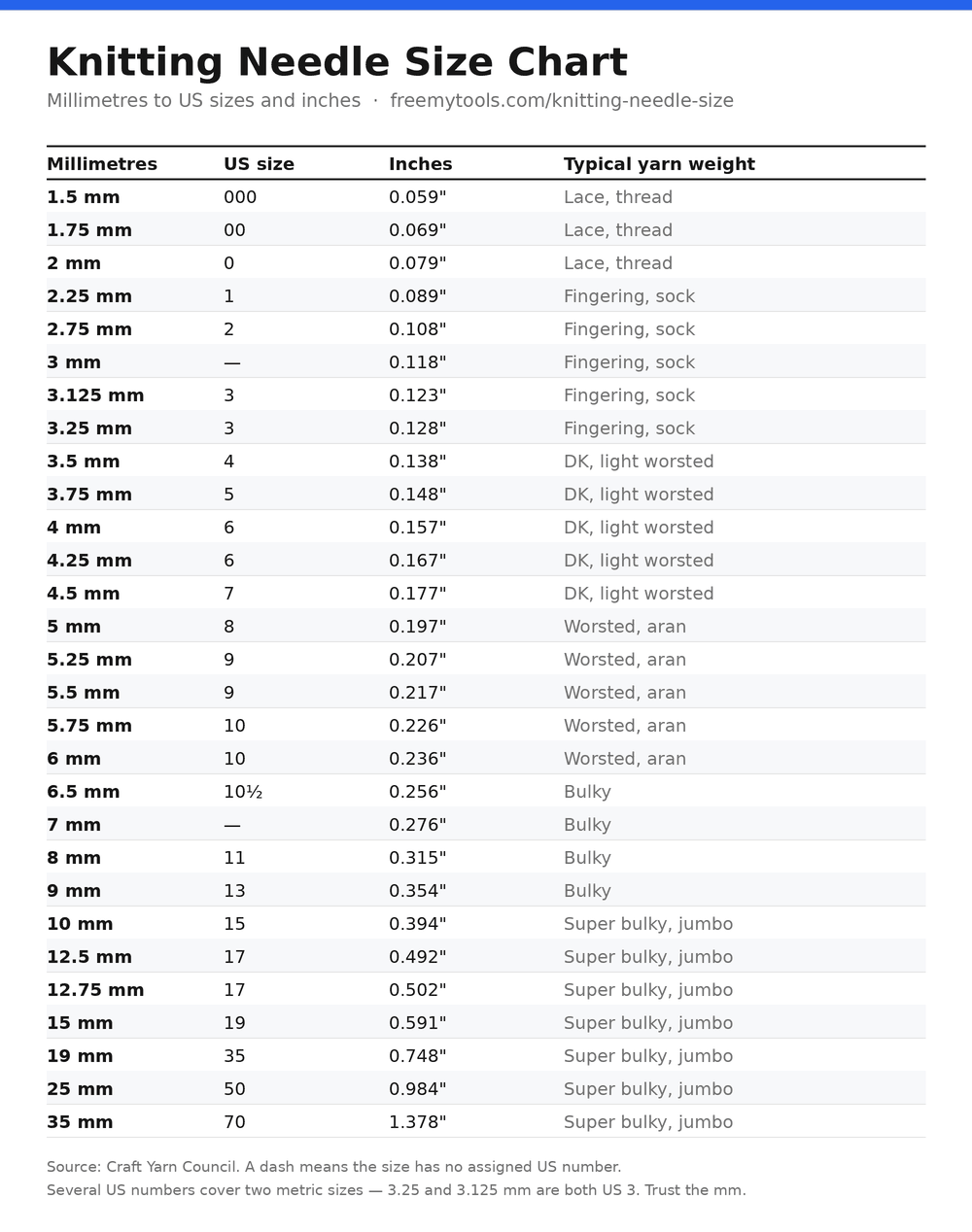
This knitting needle conversion chart gives knitting needle sizes in mm against US numbers. Millimetres are the reliable measurement — US numbers repeat across different metric sizes, and some metric sizes have no US number at all.
| Millimetres | US size | Inches | Typical yarn |
|---|---|---|---|
| 1.5 mm | 000 | 0.059″ | Lace, thread |
| 1.75 mm | 00 | 0.069″ | Lace, thread |
| 2 mm | 0 | 0.079″ | Lace, thread |
| 2.25 mm | 1 | 0.089″ | Fingering, sock |
| 2.75 mm | 2 | 0.108″ | Fingering, sock |
| 3 mm | — | 0.118″ | Fingering, sock |
| 3.125 mm | 3 | 0.123″ | Fingering, sock |
| 3.25 mm | 3 | 0.128″ | Fingering, sock |
| 3.5 mm | 4 | 0.138″ | DK, light worsted |
| 3.75 mm | 5 | 0.148″ | DK, light worsted |
| 4 mm | 6 | 0.157″ | DK, light worsted |
| 4.25 mm | 6 | 0.167″ | DK, light worsted |
| 4.5 mm | 7 | 0.177″ | DK, light worsted |
| 5 mm | 8 | 0.197″ | Worsted, aran |
| 5.25 mm | 9 | 0.207″ | Worsted, aran |
| 5.5 mm | 9 | 0.217″ | Worsted, aran |
| 5.75 mm | 10 | 0.226″ | Worsted, aran |
| 6 mm | 10 | 0.236″ | Worsted, aran |
| 6.5 mm | 10½ | 0.256″ | Bulky |
| 7 mm | — | 0.276″ | Bulky |
| 8 mm | 11 | 0.315″ | Bulky |
| 9 mm | 13 | 0.354″ | Bulky |
| 1 mm | 15 | 0.394″ | Super bulky, jumbo |
| 12.5 mm | 17 | 0.492″ | Super bulky, jumbo |
| 12.75 mm | 17 | 0.502″ | Super bulky, jumbo |
| 15 mm | 19 | 0.591″ | Super bulky, jumbo |
| 19 mm | 35 | 0.748″ | Super bulky, jumbo |
| 25 mm | 50 | 0.984″ | Super bulky, jumbo |
| 35 mm | 70 | 1.378″ | Super bulky, jumbo |
Source: Craft Yarn Council, verified 5 August 2026. A dash means the size has no assigned US number.
Free Printable Knitting Needle Size Chart
Worth keeping a copy in your project bag. The size stamped on a needle end wears away with use — on bamboo and birch it is often faint when new — and an unmarked needle in the middle of a project is exactly when you cannot get to a screen. Use the button below and your browser will produce a real PDF; nothing is asked of you in return.
How to Measure a Knitting Needle
Measure the shaft — the straight section the stitches slide along. Not the tapered tip, which is thinner, and not the join on a circular needle, which is usually thicker. The shaft diameter is what forms the stitch, and it is what the printed number refers to.
- Calibrate the gauge above against a bank card. It takes ten seconds and is saved.
- Lay the needle flat against the screen, shaft across the circles.
- Find the circle the shaft covers exactly — not one it sits inside.
Below 4 mm, adjacent sizes are often 0.25 mm apart, which is difficult to judge against a ruler's markings. Matching an area is easier than reading a scale, which is why physical needle gauges exist at all — this is the same idea, on your screen.
Why US Numbers Repeat
The US system has fewer steps than the metric one, so several US numbers cover two metric sizes each:
- US 3 — both 3.125 mm and 3.25 mm
- US 6 — both 4 mm and 4.25 mm
- US 9 — both 5.25 mm and 5.5 mm
- US 10 — both 5.75 mm and 6 mm
- US 17 — both 12.5 mm and 12.75 mm
That is a genuine ambiguity, not a chart error. Two needles both marked US 6 can differ by 0.25 mm, which is enough to shift your gauge. It is the reason patterns and yarn labels increasingly print millimetres, and the reason to trust the metric marking when the two disagree.
Three sizes in common circulation — 2.5 mm, 3 mm and 7 mm — have no US number at all. A chart that gives you one has invented it.
Needle Size for Yarn Weight
The typical-yarn column in the chart is a starting point, and the yarn's own ball band is a better one — it prints a recommended needle size and a gauge for a reason. Where the two disagree, follow the band and then follow your swatch.
| Yarn weight | Needle size | US |
|---|---|---|
| Lace (0) | 1.5–2.25 mm | 000–1 |
| Fingering / sock (1) | 2.25–3.25 mm | 1–3 |
| Sport (2) | 3.25–3.75 mm | 3–5 |
| DK / light worsted (3) | 3.75–4.5 mm | 5–7 |
| Worsted / aran (4) | 4.5–5.5 mm | 7–9 |
| Chunky / bulky (5) | 5.5–8 mm | 9–11 |
| Super bulky (6) | 8–12.75 mm | 11–17 |
| Jumbo (7) | 12.75 mm and up | 17 and up |
Craft Yarn Council standard yarn weight system. The ranges overlap deliberately — yarn weight is a band, not a point.
Circular, Double-Pointed and Interchangeable Needles
Needle size means the same thing on every format: it is the shaft diameter, and this chart applies to all of them. What changes is everything else about the needle, which is where the confusion usually sits.
- Circulars carry two numbers — the needle size and the cord length, in inches or centimetres. A 4 mm 40 cm and a 4 mm 100 cm knit identically; the cord decides what circumference you can work, not your gauge. Too long a cord for a small circumference is why magic loop exists.
- Double-pointed needles are sized identically and sold by length as well — 15, 20 and 25 cm are common. Length is a comfort choice.
- Interchangeable tips are sized on the tip, not the cable, and the smallest sizes are often missing from a set because the join would be too fragile. That is why a set advertised as "3.5 mm to 10 mm" starts where it does.
Material changes your gauge even when the size does not. Metal is slick and tends to produce looser fabric; bamboo and wood grip the yarn and tend to produce tighter. Two needles both stamped 4 mm in different materials can genuinely give you different swatches, which is one more reason the swatch is the thing that decides.
Needles and Hooks Are Not Interchangeable
A 4 mm knitting needle and a 4 mm crochet hook have the same diameter, but the numbering is completely different: 4 mm is US 6 as a needle and US G-6 as a hook. A gauge measures diameter correctly for both, but the size label beside the hole will only be right for one. Use the crochet hook chart for hooks.
Accuracy and Limits
- Calibrate at 100% browser zoom, and recalibrate if you change it.
- Look straight at the screen. Judging a circle edge at an angle introduces parallax.
- Measure the shaft on a circular needle, never the cable or the join.
Calibrated carefully, the gauge separates adjacent sizes reliably. For a garment, it is still worth knitting a swatch — the needle size is a starting point, and the gauge you achieve is what actually decides the finished measurements.