Crochet Hook Size Chart: mm to US
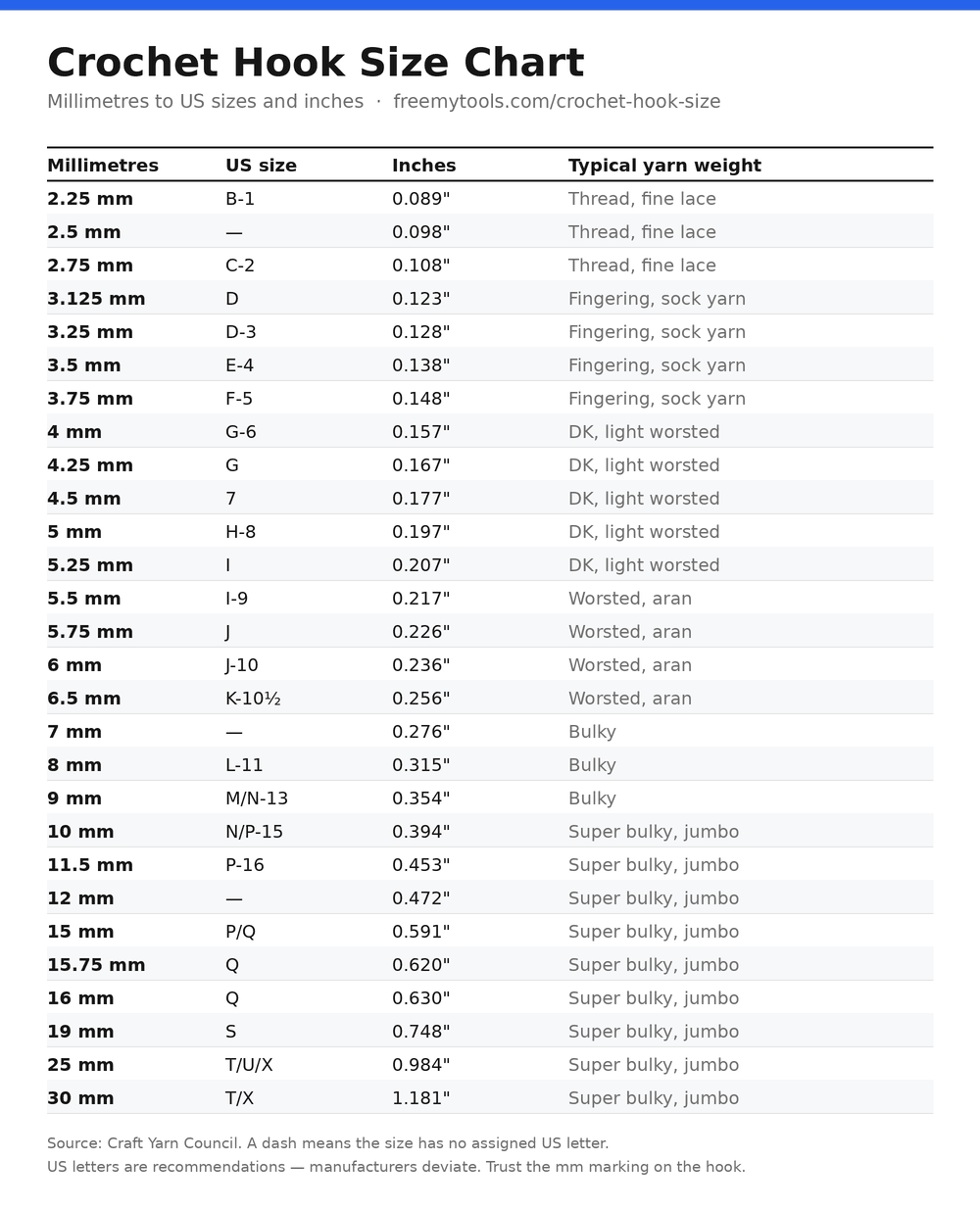
This crochet hook size conversion chart gives crochet hook sizes in mm to US letters and numbers. Millimetres are the reliable measurement. US letters and numbers are conventions that vary between manufacturers, and several common sizes have no assigned letter at all. Where a chart and a hook disagree, trust the millimetre marking on the hook.
| Millimetres | US size | Inches | Typical use |
|---|---|---|---|
| 2.25 mm | B-1 | 0.089″ | Thread, fine lace |
| 2.5 mm | — | 0.098″ | Thread, fine lace |
| 2.75 mm | C-2 | 0.108″ | Thread, fine lace |
| 3.125 mm | D | 0.123″ | Fingering, sock yarn |
| 3.25 mm | D-3 | 0.128″ | Fingering, sock yarn |
| 3.5 mm | E-4 | 0.138″ | Fingering, sock yarn |
| 3.75 mm | F-5 | 0.148″ | Fingering, sock yarn |
| 4 mm | G-6 | 0.157″ | DK, light worsted |
| 4.25 mm | G | 0.167″ | DK, light worsted |
| 4.5 mm | 7 | 0.177″ | DK, light worsted |
| 5 mm | H-8 | 0.197″ | DK, light worsted |
| 5.25 mm | I | 0.207″ | DK, light worsted |
| 5.5 mm | I-9 | 0.217″ | Worsted, aran |
| 5.75 mm | J | 0.226″ | Worsted, aran |
| 6 mm | J-10 | 0.236″ | Worsted, aran |
| 6.5 mm | K-10½ | 0.256″ | Worsted, aran |
| 7 mm | — | 0.276″ | Bulky |
| 8 mm | L-11 | 0.315″ | Bulky |
| 9 mm | M/N-13 | 0.354″ | Bulky |
| 1 mm | N/P-15 | 0.394″ | Super bulky, jumbo |
| 11.5 mm | P-16 | 0.453″ | Super bulky, jumbo |
| 12 mm | — | 0.472″ | Super bulky, jumbo |
| 15 mm | P/Q | 0.591″ | Super bulky, jumbo |
| 15.75 mm | Q | 0.620″ | Super bulky, jumbo |
| 16 mm | Q | 0.630″ | Super bulky, jumbo |
| 19 mm | S | 0.748″ | Super bulky, jumbo |
| 25 mm | T/U/X | 0.984″ | Super bulky, jumbo |
| 3 mm | T/X | 1.181″ | Super bulky, jumbo |
Free Printable Crochet Hook Size Chart
The chart above is free to print or save as a PDF — no email, no sign-up, no download wall. Printing gives you the table on one sheet with the site chrome stripped out; the image below is the same data as a single file, if you would rather save it to your phone or pin it to a craft board.
Reading the Chart as a Beginner
If you are new to crochet, the only number that matters is the one in millimetres. A pattern that says "4 mm hook" means the shaft is 4 mm across, and any hook marked 4 mm will do regardless of brand, material or what letter is printed beside it. Start there and ignore the rest of the chart until you need it.
The US column exists because American patterns and packaging often give a letter instead — G-6, H-8, I-9. Those letters are a convention rather than a measurement, which is why this chart puts them second. The inches column is there for anyone measuring with an imperial ruler, though at these sizes millimetres are far easier to read: the gap between two adjacent hooks can be as little as 0.25 mm, which is a hundredth of an inch.
A practical starting kit is 4 mm, 5 mm and 6 mm. Those cover DK, worsted and aran yarn, which is most beginner patterns and most of what a general craft shop stocks. Add sizes as patterns ask for them rather than buying a full set you will not use.
Source: Craft Yarn Council, verified 5 August 2026. A dash means the size has no assigned US letter.
How to Measure a Crochet Hook
To convert crochet hook size to mm yourself, measure the shaft — the straight section between the hook head and the thumb rest. Not the head, which is wider, and not the handle, which is wider still. The shaft is what the yarn wraps around, so it is what sets your stitch size, and it is what the printed number refers to.
- Calibrate the gauge above against a bank card. This takes ten seconds and is saved.
- Hold the hook flat against the screen, shaft across the circles.
- Find the circle the shaft covers exactly — not the one it sits inside.
Below 4 mm the gap between adjacent sizes is often 0.25 mm, which is genuinely hard to judge on a ruler. Comparing against a circle of known diameter is more forgiving, because you are matching an area rather than reading a scale.
Why Hook Letters Disagree Between Brands
The Craft Yarn Council publishes recommended letter-to-millimetre pairings, but they are recommendations. Manufacturers are free to deviate and some do — you will find hooks marked "G" at both 4 mm and 4.25 mm, and "Q" at 15.75 mm and 16 mm. Older hooks and imports follow their own conventions.
Three sizes in common circulation — 2.5 mm, 7 mm, and 12 mm — have no assigned US letter whatsoever. If a chart gives you one, it invented it.
Older UK numbering makes this worse by running backwards: a higher UK number means a smaller hook. That system is legacy and was inconsistently applied even when it was current, so this page deliberately does not publish a UK conversion column. Measuring the shaft is more reliable than any table.
Which Hook Size for Which Yarn
A starting point, not a rule — your tension decides the final answer:
- Lace / thread — 1.5 to 2.25 mm
- Fingering, sock — 2.25 to 3.5 mm (US B-1 to E-4)
- DK, light worsted — 3.5 to 4.5 mm (US E-4 to 7)
- Worsted, aran — 5 to 6.5 mm (US H-8 to K-10½)
- Bulky — 6.5 to 9 mm (US K-10½ to M/N-13)
- Super bulky, jumbo — 9 mm and up
Always work a gauge swatch before a garment. Two people using the same hook and the same yarn routinely produce fabric that differs by a full size, because tension is personal. If your swatch has too many stitches per 10 cm, move up a hook size; too few, move down.
Accuracy and Limits
The gauge is as accurate as your calibration. Calibrated carefully against a card it is typically within a few tenths of a millimetre — enough to separate adjacent hook sizes. Two things degrade it:
- Browser zoom. Calibrate at 100%, and recalibrate if you change it.
- Viewing angle. Look straight at the screen. Judging a circle edge at an angle introduces parallax.
This chart covers standard yarn hooks. Steel thread hooks use a separate numbering system running roughly 0.6 mm to 3.5 mm, where higher numbers mean smaller hooks — a steel 7 and an aluminium 7 have nothing to do with each other. If your hook is very fine and marked with a number above 10, it is a steel hook and this table does not apply.